
Program detalis
Robotics
Robotics
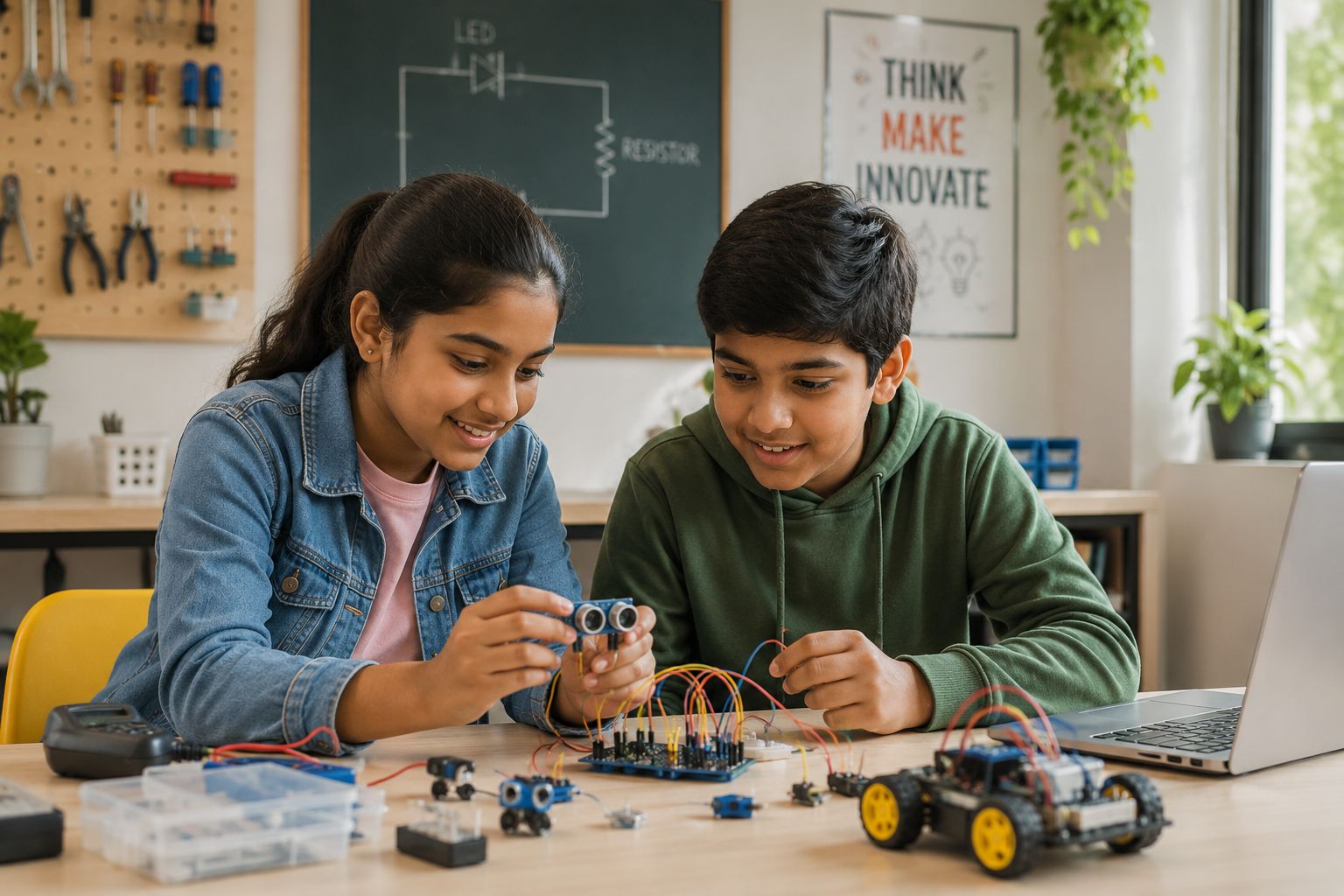
Robotics makes abstract ideas move. Children discover how structure, code, sensors, and simple mechanisms come together to create a responsive machine. Every test is a chance to observe, adjust, and build a better version.
Robotics makes abstract ideas move. Children discover how structure, code, sensors, and simple mechanisms come together to create a responsive machine. Every test is a chance to observe, adjust, and build a better version.
Start date:
Group size:
Small & Focused
Program type:
Half day
Age Range:
3–4 years old

Start date:
Group size:
Small & Focused
Program type:
Half day
Age Range:
3–4 years old
Program detalis
Robotics
Robotics makes abstract ideas move. Children discover how structure, code, sensors, and simple mechanisms come together to create a responsive machine. Every test is a chance to observe, adjust, and build a better version.
Start date:
Group size:
Small & Focused
Program type:
Half day
Age Range:
3–4 years old
Programme Overview
Robotics makes learning visible. A line of code is no longer only something on a screen; it can become a movement, a light, a sound, or a response. This tangible connection helps children understand that technology is created through many small decisions that work together.
The programme encourages learners to combine imagination with practical thinking. They consider what a robot should do, what information it may need, how it should respond, and what needs to change when the first attempt is not quite right. Along the way, they begin to appreciate that building is rarely a one-step process. It is a cycle of trying, noticing, and improving.
What Learners Explore
Learning Theme | Description |
Structure and movement | Children explore how parts fit together and how a carefully considered build can move or perform a simple task. |
Code in action | Learners see how instructions influence a robot’s behaviour, turning abstract logic into a physical response. |
Sensors and feedback | Through age-appropriate activities, children discover how a robotic creation can detect information and react to it. |
Testing and improvement | Learners practise observing a prototype closely, identifying a problem, and making purposeful changes. |
How Learning Feels
Robotics sessions are active, collaborative, and full of small experiments. A child might begin with a simple objective—make a model move, follow a path, respond to a signal, or complete a tiny challenge. The interesting part is what happens next: the wheel turns in the wrong direction, a sensor responds too soon, or a structure needs more balance. These moments are not failures. They are the material of learning.
Mentorship helps children slow down and ask useful questions: What did the robot do? What did we expect it to do? Which part should we test first? This habit of careful observation is as valuable as the finished creation.
Possible Project Directions
Moving machines · Path-following challenges · Sensor-based responses · Simple automated helpers · Mini robot missions · Creative mechanical builds
What This Programme Can Help Children Practise
Robotics gives children opportunities to practise spatial thinking, sequencing, patient testing, problem-solving, and collaborative communication. It also gives them the satisfying experience of seeing their own instructions become a real-world action.
Parent Note
Robotics is particularly engaging for children who enjoy building, vehicles, science experiments, puzzles, or figuring out how everyday machines work. Learners can begin with accessible builds and progress towards more involved projects as their confidence develops.
Programme Overview
Robotics makes learning visible. A line of code is no longer only something on a screen; it can become a movement, a light, a sound, or a response. This tangible connection helps children understand that technology is created through many small decisions that work together.
The programme encourages learners to combine imagination with practical thinking. They consider what a robot should do, what information it may need, how it should respond, and what needs to change when the first attempt is not quite right. Along the way, they begin to appreciate that building is rarely a one-step process. It is a cycle of trying, noticing, and improving.
What Learners Explore
Learning Theme | Description |
Structure and movement | Children explore how parts fit together and how a carefully considered build can move or perform a simple task. |
Code in action | Learners see how instructions influence a robot’s behaviour, turning abstract logic into a physical response. |
Sensors and feedback | Through age-appropriate activities, children discover how a robotic creation can detect information and react to it. |
Testing and improvement | Learners practise observing a prototype closely, identifying a problem, and making purposeful changes. |
How Learning Feels
Robotics sessions are active, collaborative, and full of small experiments. A child might begin with a simple objective—make a model move, follow a path, respond to a signal, or complete a tiny challenge. The interesting part is what happens next: the wheel turns in the wrong direction, a sensor responds too soon, or a structure needs more balance. These moments are not failures. They are the material of learning.
Mentorship helps children slow down and ask useful questions: What did the robot do? What did we expect it to do? Which part should we test first? This habit of careful observation is as valuable as the finished creation.
Possible Project Directions
Moving machines · Path-following challenges · Sensor-based responses · Simple automated helpers · Mini robot missions · Creative mechanical builds
What This Programme Can Help Children Practise
Robotics gives children opportunities to practise spatial thinking, sequencing, patient testing, problem-solving, and collaborative communication. It also gives them the satisfying experience of seeing their own instructions become a real-world action.
Parent Note
Robotics is particularly engaging for children who enjoy building, vehicles, science experiments, puzzles, or figuring out how everyday machines work. Learners can begin with accessible builds and progress towards more involved projects as their confidence develops.
Releted programs

Releted programs
Releted programs
Join our learning community today
Join our learning community today
Support your child’s growth with a nurturing environment designed for learning, creativity, and confidence.
Support your child’s growth with a nurturing environment designed for learning, creativity, and confidence.



Join our learning community today
Support your child’s growth with a nurturing environment designed for learning, creativity, and confidence.
